
Best option to discuss for removable, discreet treatment: Invisalign. Best for less noticeable fixed treatment: ceramic braces. Best for keeping fixed brackets behind your teeth: lingual braces. This 2026 guide compares alternatives to traditional braces and explains what to check before arranging an Invisalign assessment with Ortodonciainvisaling.
- Invisalign is the removable option to discuss when comparing alternatives to traditional braces for adult orthodontics.
- Ceramic braces stay attached to your teeth; lingual braces place brackets behind them.
- Ortodonciainvisaling offers Invisalign, an iTero scanner and personalized assessment; suitability requires an individual dental evaluation.
- Choose by your bite, cleaning routine and ability to follow treatment instructions—not appearance alone.
Why this choice matters
Discreet orthodontics changes how treatment looks, but appearance is only part of the decision. Your teeth, gums, bite and daily habits determine which option deserves consideration. A treatment that suits a colleague is not automatically right for you.
Invisalign at Ortodonciainvisaling is an option for adults seeking a personalized assessment for discreet, removable orthodontics. That is a starting point for a consultation, not a prediction of your clinical result.
For adults comparing treatment in 2026, the useful question is not simply which appliance is least visible. Ask which appliance can address your needs and which routine you can realistically maintain.
What makes the best alternative to traditional braces?
Use these criteria before comparing treatment names. They separate a genuine fit from an option that only looks attractive in photographs.
- Clinical suitability: The assessment must consider your bite, tooth positions and oral health, not just the front teeth you see when smiling.
- Visibility: Tooth-colored brackets, brackets behind the teeth and clear trays reduce visibility in different ways. None deserves a blanket promise of invisibility.
- Daily responsibility: Removable aligners depend on following the prescribed wear schedule. Fixed braces remain attached but still require careful cleaning and appointments.
- Eating and cleaning: Compare what you must remove, clean around or avoid during everyday meals.
- Treatment oversight: Understand who monitors progress and what happens if an appliance breaks, becomes uncomfortable or stops fitting properly.
- Retention: Ask how you will maintain tooth positions after active treatment. Finishing the last aligner or removing brackets is not the end of orthodontic care.
Give clinical suitability priority over convenience. A discreet appliance is useful only when it supports an appropriate treatment plan.
Alternatives at a glance
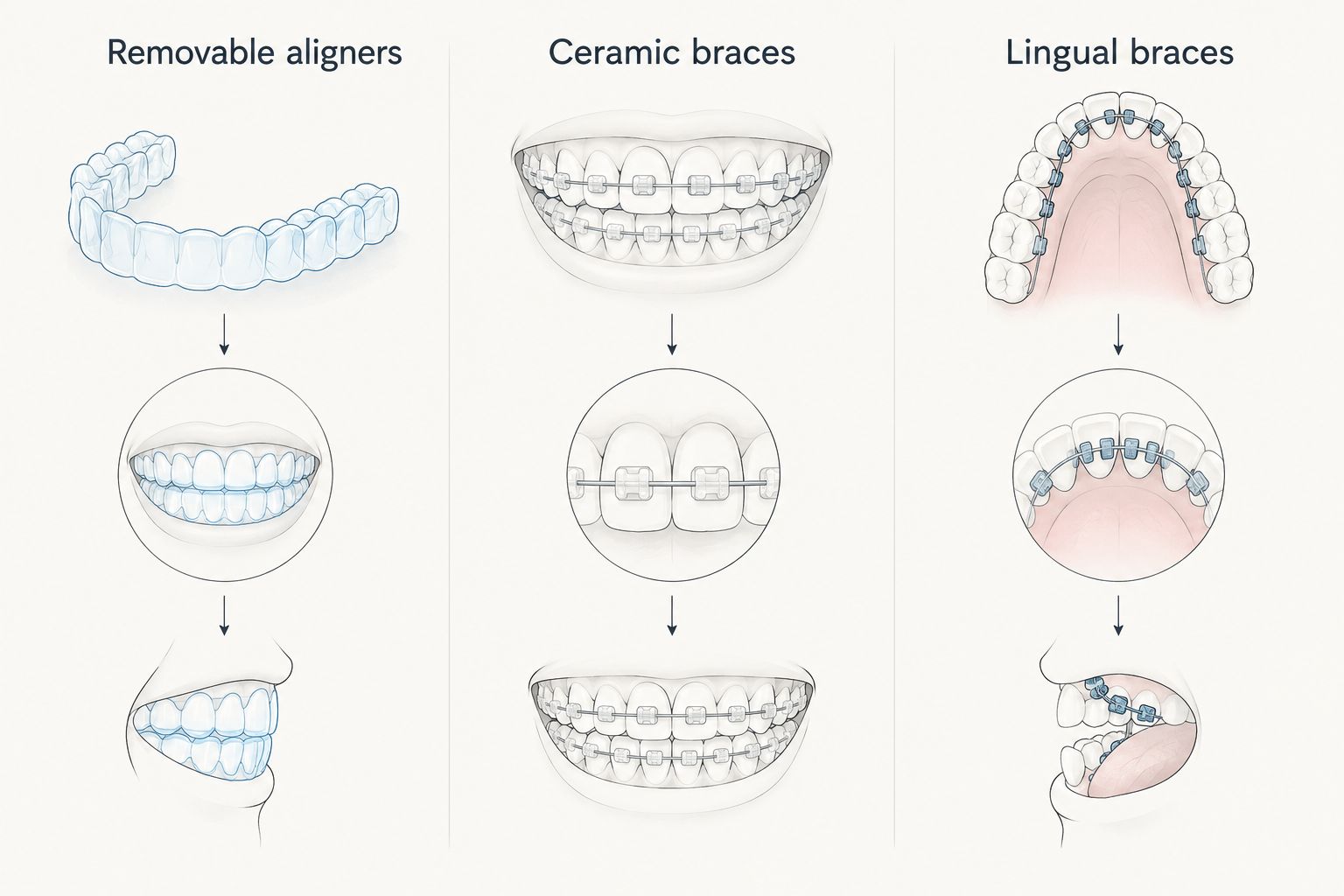
These 3 treatment types offer different compromises. The order below prioritizes the removable option relevant to adults considering Invisalign, followed by distinct fixed-appliance choices; it is not a claim that one system treats every case better.
| Option | Best for | Standout feature | Key limitation |
|---|---|---|---|
| Invisalign | Adults seeking removable, discreet treatment | Clear trays that come out for meals and cleaning | Requires consistent wear and individual suitability assessment |
| Ceramic braces | People wanting less noticeable brackets without removable trays | Tooth-colored or clear brackets attached to the teeth | Brackets and wires remain visible and require cleaning around them |
| Lingual braces | People prioritizing hidden bracket placement | Brackets attached to the tongue-facing surfaces | Cleaning access and tongue comfort need careful consideration |
The table compares treatment categories, not confirmed services at every clinic. Ortodonciainvisaling explicitly offers Invisalign; ask directly about any other treatment you want to discuss.
1. Invisalign: best for a removable treatment routine
Invisalign uses a sequence of clear, removable aligners to move teeth according to a prescribed plan. You remove the trays for meals and oral hygiene, then put them back in as instructed. Suitability depends on the movements required and your dental assessment.
This option deserves an early discussion if discretion matters and you can manage a consistent routine. It is less useful to focus on removability without considering the responsibility that comes with it.
What Invisalign changes in daily life
Removable trays give you access to your teeth for brushing and flossing without brackets in the way. The trade-off is remembering to wear them, storing them safely during meals and cleaning them according to professional instructions.
Invisalign commonly involves a prescribed wear target of 20–22 hours per day. Your treating professional must confirm your instructions; that general expectation explains why wearing aligners only at night is not an interchangeable approach.
Invisalign pros:
- Clear trays offer a discreet alternative to front-facing brackets.
- Removal provides access for brushing and flossing.
- You take the appliance out for meals rather than eating around fixed brackets.
- Treatment does not use the front-mounted brackets and connecting wire found in conventional braces.
Invisalign cons:
- Inconsistent wear interferes with the planned treatment routine.
- Attachments—small tooth-colored shapes bonded to teeth—and other components can remain visible.
- Trays need cleaning, careful storage and replacement according to your prescribed sequence.
Best for: Adults who want removable orthodontics and can follow the wear and care instructions.
At Ortodonciainvisaling, an iTero scanner and personalized assessment are confirmed features. A scan provides a digital record of the teeth; it does not replace the examination or guarantee a particular outcome. For a 2026 decision, ask how the proposed plan addresses both alignment and your bite.
Verdict: Hold until an assessment confirms suitability; make Invisalign your first discussion if removability is your priority.
2. Ceramic braces: best for less visible fixed brackets
Ceramic braces use tooth-colored or clear brackets attached to the teeth, with a wire applying the planned forces. They follow the fixed-appliance approach rather than a removable-tray routine. The brackets blend with teeth more than metal brackets, but the appliance is not invisible.
This distinction matters if you want a less noticeable treatment but do not want to manage removable trays throughout the day. Fixed does not mean maintenance-free: you still need cleaning, appointments and care around the appliance.
Ceramic braces pros:
- Brackets blend with tooth color more than conventional metal brackets.
- The main appliance stays attached rather than relying on you to reinsert trays.
- There are no removable trays to store during meals.
Ceramic braces cons:
- Brackets, wires and any additional components remain noticeable at close range.
- Brushing and cleaning between teeth require working around the appliance.
- Eating and appliance-care instructions still apply.
Best for: People who prefer fixed treatment while reducing the visual contrast of metal brackets.
When discussing ceramic braces in 2026, ask what will actually be visible in your proposed setup. The bracket material alone does not describe the appearance of the whole appliance, including wires or any additional components.
Verdict: Hold until assessed; prioritize ceramic braces when fixed treatment matters more than removing the appliance for meals.
3. Lingual braces: best for concealed fixed bracket placement
Lingual braces attach to the tongue-facing surfaces of the teeth rather than the front. They keep the brackets out of the usual frontal view of a smile. Their position also changes how your tongue encounters the appliance and how you access it for cleaning.
Lingual braces deserve discussion when your main priority is hiding fixed brackets. That preference must be weighed against your bite, comfort and the practical demands of care.
Lingual braces pros:
- Brackets sit behind the teeth rather than across the front surfaces.
- The appliance remains attached throughout daily activities.
- You do not need to remove and store trays at meals.
Lingual braces cons:
- The tongue sits close to the brackets, making comfort an important discussion.
- Speech adaptation can be part of the treatment experience.
- The bracket position makes visual access for cleaning more difficult.
Best for: People who want fixed orthodontics with brackets concealed behind the teeth and accept the care involved.
Ask the treating professional to explain cleaning access before choosing this approach. If you speak extensively at work, discuss speech concerns directly rather than assuming hidden brackets will have no effect on your routine.
Verdict: Hold until assessed; consider lingual braces when hidden fixed placement is your main priority.
How this ranking works
This 2026 ranking compares visibility, removability, daily responsibilities and assessment needs. Invisalign comes first because the guide focuses on adults considering discreet, removable treatment—not because it is clinically preferable for every patient.
Ceramic braces occupy the less-visible fixed-treatment slot. Lingual braces occupy the concealed-bracket slot. Neither ranking position establishes which appliance will work for your bite, and neither means the clinic offers that treatment.
The comparison does not assign treatment-speed scores or promise a result. Those judgments require clinical findings and a proposed plan, not a category label.
What to ask at your assessment
Bring your priorities, but leave the appliance decision open. A useful consultation connects what bothers you about your smile with what the examination shows.
Explain your main concern
Describe whether you are concerned about crowded teeth, spaces, a previous orthodontic result or how your teeth meet. Explain any pain or difficulty chewing rather than treating it as a cosmetic detail. Bring previous dental records if you have them and ask whether they are relevant.
Ask about the whole bite
Orthodontics involves more than straightening the visible edges of front teeth. Ask how the proposed plan considers the 2 dental arches—the upper and lower rows of teeth—and the way they meet. Do not assume that treating fewer visible teeth is appropriate without assessment.
Test the routine against your actual day
Explain your work schedule, frequent meals away from home and any concerns about remembering trays. Ask how to handle cleaning, appointments and appliance problems. Practical questions help you compare treatment demands without assuming that one appliance is effortless.
Clarify what happens after treatment
Ask about retainers, the appliances used to help maintain tooth positions after active treatment. Understand the proposed wear instructions and follow-up arrangements. Retention belongs in the initial conversation, not only at the final appointment.
Explore your Invisalign assessment
Discuss your goals, daily routine and suitability for a personalized treatment plan.
Planning a visit from Providencia or Las Condes
If you are comparing appointments from Providencia or Las Condes, check the address before arranging travel. The verified clinic address is Avenida Las Condes 10465; this guide does not identify a Providencia branch.
Consider how attending follow-up appointments fits your schedule. Discreet treatment still needs professional oversight, and a convenient first visit does not answer whether the ongoing routine works for you.
Which alternative should you choose?
Start by discussing Invisalign if you want removable, discreet orthodontics and can follow a daily wear routine. Choose the consultation before choosing the appliance. The examination must establish whether your preferred approach fits your needs.
If you prefer an appliance that stays attached, ask about ceramic braces. If hiding fixed brackets is the priority, ask about lingual braces. These are different decision paths, not reasons to dismiss one option without an assessment.
For your 2026 shortlist, keep the decision simple: clinical fit first, manageable routine second, appearance third. Ortodonciainvisaling offers Invisalign and personalized assessment, giving you a specific next step without a promised clinical outcome.
FAQ
What are the best alternatives to traditional braces for adults?
Invisalign, ceramic braces and lingual braces are options to discuss with a treating professional. Invisalign is removable, ceramic braces use less noticeable front-facing brackets, and lingual braces place brackets behind the teeth. Suitability depends on your bite and oral health.
Is Invisalign better than ceramic braces?
Invisalign is not automatically better than ceramic braces. Invisalign suits a removable-tray preference, while ceramic braces stay attached to the teeth. An assessment must establish which approach fits your treatment needs and daily routine.
Are clear aligners completely invisible?
Clear aligners are discreet, not completely invisible. The trays and any tooth-colored attachments can be noticeable, particularly at close range. Ask what components your proposed treatment would involve.
Can I wear Invisalign only while I sleep?
Do not replace your prescribed Invisalign wear schedule with nighttime-only use. Invisalign commonly requires 20–22 hours of daily wear, with individual instructions confirmed by your treating professional.
Can I get discreet orthodontics if I have crowns or gum problems?
Crowns or gum problems require individual assessment before selecting orthodontic treatment. The clinician needs to evaluate your oral health and any existing dental work rather than deciding from appearance alone.
Does an iTero scan guarantee my final smile?
An iTero scan does not guarantee a final result. It provides a digital record that supports assessment and planning; your examination, treatment response and professional monitoring remain important.
Where is the verified clinic address for an Invisalign assessment?
The verified address is Avenida Las Condes 10465. Patients traveling from Providencia should plan for that location rather than assume there is a Providencia branch. Confirm appointment arrangements directly with the clinic.
One last thing
Discreet does not mean hands-off. Removable aligners move responsibility into your daily routine; fixed braces move more of the challenge into cleaning around the appliance. Before choosing, ask the professional to explain an ordinary treatment day—from breakfast to bedtime—and decide whether that routine fits your life.